
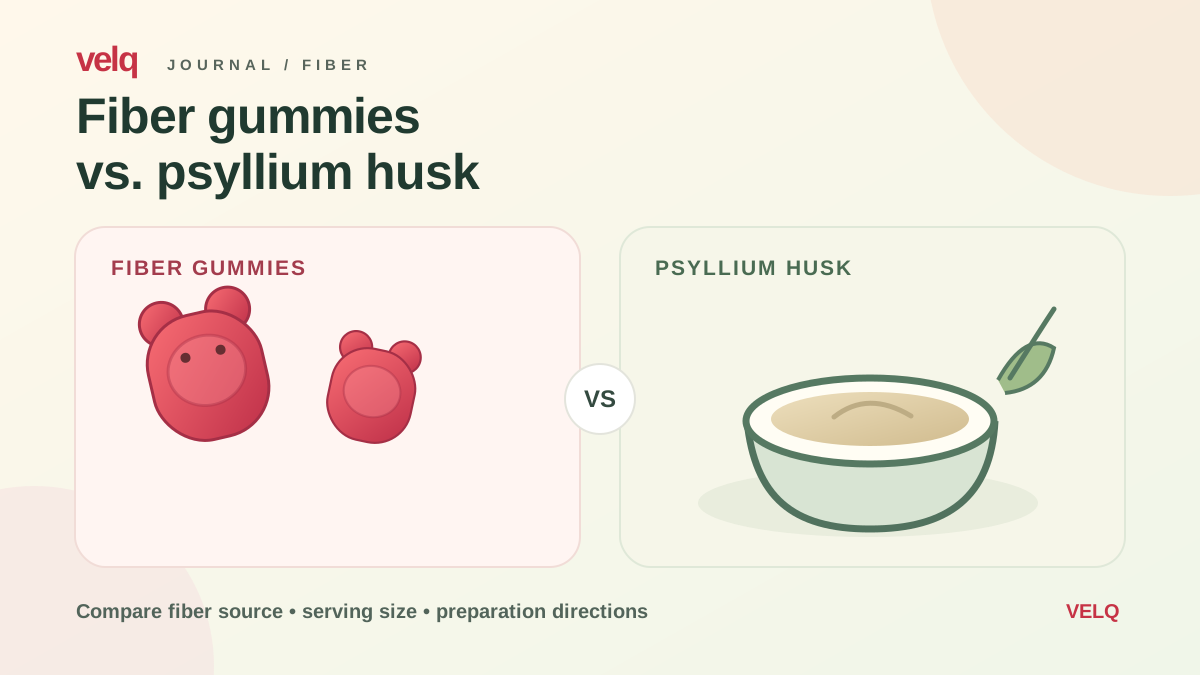
Fiber gummies are a format; psyllium is a specific soluble, gel-forming fiber. Whether one fits you better depends on the actual fiber source, dose, instructions and what you want—not on gummies versus powder alone.
Quick answer
Consider gummies if the portable, ready-to-eat format fits your routine and its full labeled serving provides the type and quantity of fiber you want. Consider psyllium when you specifically want psyllium's bulk-forming properties and can follow the fluid and dosing instructions for that product. Different fibers are not automatically interchangeable.
| What to check | Fiber gummies | Psyllium husk |
|---|---|---|
| Fiber type | Varies: read the ingredient list for inulin, polydextrose or another listed source | Psyllium husk, a named bulk-forming fiber |
| Serving | Could be multiple pieces or one pack; count total dietary fiber grams | Label specifies the recommended powder, capsule or other portion |
| Preparation | Usually ready to eat; follow that product's directions | Powders require adequate liquid and specific preparation; read the warning |
| Other ingredients | Check added sugars, sweeteners, allergens and possible caffeine | Check additives, flavorings and medication guidance for the exact product |
| True cost | Price per labeled 5g fiber, while considering fiber type | Price per labeled 5g fiber, while considering fiber type |
Why the exact fiber ingredient matters
Psyllium absorbs liquid and forms a bulkier stool; its OTC labeling often includes important fluid warnings. Other fibers, including some used in gummies, may be fermentable and act differently in the gut. You cannot assume that an inulin gummy supplies psyllium's same clinical effects just because its label lists a similar gram amount.
For the safety directions on psyllium, review the MedlinePlus psyllium information. It explains that psyllium powders and granules must be mixed with liquid and warns users to follow dosage and medication-related instructions.
A five-point buying checklist
- Find the named source: Look for psyllium, inulin, polydextrose or another ingredient rather than relying on “fiber” on the front.
- Count the full serving: Is the displayed fiber for one gummy, several gummies or a whole packet?
- Check every active ingredient: A fiber gummy might also have caffeine, protein or other supplements.
- Read the exact directions: Psyllium requires appropriate fluid; do not improvise dosage from another brand.
- Compare cost intelligently: Use price per serving and price per labeled gram of fiber alongside tolerance and the source of fiber.
Compare two nutrition labels with the free Velq calculator →
Will either one always improve digestion?
No. Fiber can affect people differently. Increasing intake too quickly may cause gas, bloating or discomfort. People with swallowing problems, gastrointestinal illness or relevant medications should review the label and ask a clinician about appropriate choices. A varied diet of fruits, vegetables, beans and whole grains remains a good foundation for most people. For background, see MedlinePlus on dietary fiber.
How Velq relates to this comparison
Velq is developing strawberry protein-and-fiber gummies with a proposed prebiotic fiber component plus protein, caffeine and L-theanine. Velq has not identified itself as a psyllium product and should not be considered a substitute for psyllium-based fiber therapy. The final label is not yet available. If you need fiber without caffeine, this proposed product may not be the right choice.
Frequently asked questions
Are all fiber gummies made from psyllium?
No. Gummies can use multiple fiber ingredients. Check the exact product label.
Do five grams of different fiber types work the same way?
No. Solubility, viscosity and fermentability vary. Grams alone do not establish equivalent effects.
Can I replace psyllium with a gummy?
That depends on why you use psyllium and what fiber the gummy contains. Do not replace an advised treatment solely on a front-of-pack claim.
Sources and related reading
- MedlinePlus: Psyllium
- MedlinePlus: Fiber in diet
- NCCIH: Dietary approaches, prebiotics and IBS
- Gummy buying checklist
Editorial disclosure: Velq is developing functional gummies and has a commercial interest in the topic. This educational article is not a clinical comparison of finished products or individual medical advice.
A practical worksheet to use next
Open the free nutrition planning workbook: compare label values and costs, plan meal portions, or prepare questions for your care team. It works without an email signup and can be printed.
How this article was prepared
Published by Velq Editorial, the brand’s editorial byline. Read our sourcing, AI-assistance, and correction policy. This article is educational and has not been independently clinically reviewed.